ClipNest
An AI video pipeline on queues
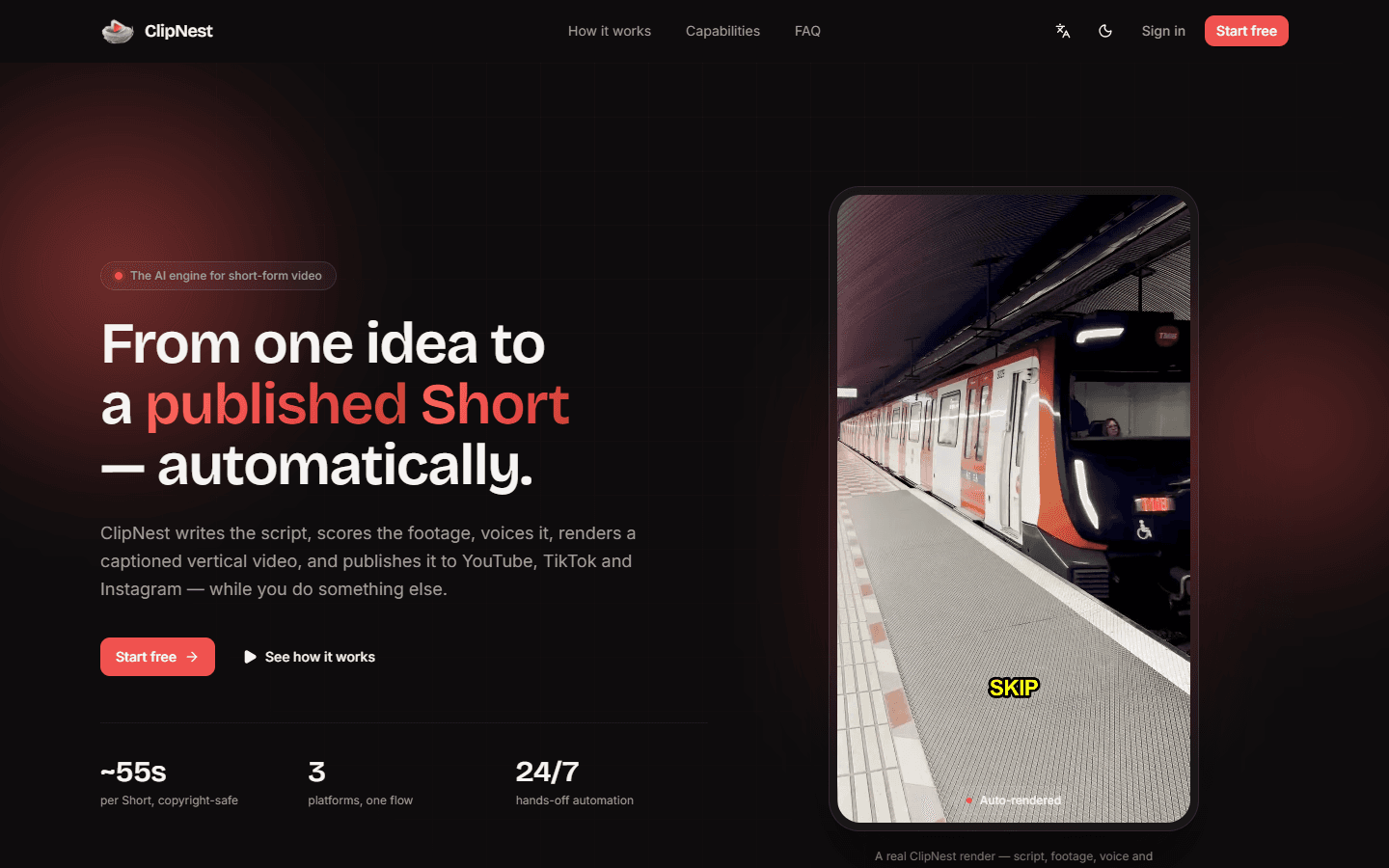
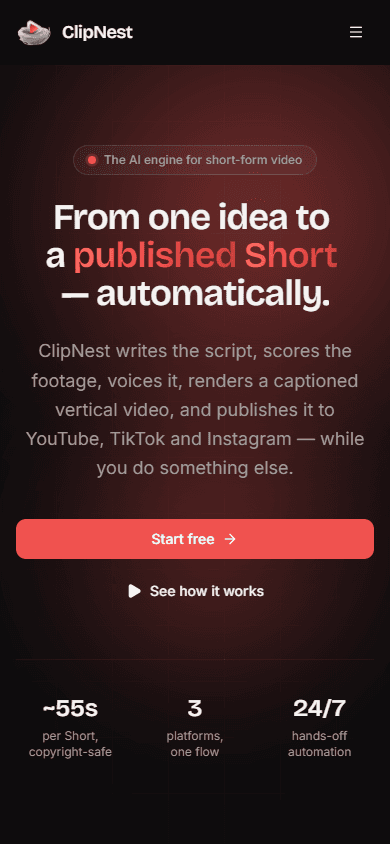
My own product: a pipeline that writes, narrates, picks footage for, renders and publishes short videos. NestJS workers on BullMQ queues, CLIP embeddings in pgvector, FFmpeg on Lambda, and a spend cap that switches the cloud off before the bill runs away. Closed beta.
- Role
- Founder and engineer: architecture, backend, infrastructure, frontend
- Years
- 2025 – now
- Status
- Own product · closed beta
- Live
- Open site ↗
§ 01Video made by a pipeline
A short video is a sequence of jobs, not a person at an editor: a script, a voice track, footage for every line, a render and a scheduled post. Each stage is a NestJS worker reading its own BullMQ queue on Redis.
§ 02Stages and queues
§ 03Matching footage with CLIP
Each line of the script is embedded with CLIP and matched against footage stored as vectors in pgvector. The footage service is the one part that runs on ECS.
§ 04Rendering on Lambda
FFmpeg runs on AWS Lambda, with the work inside one render split across parallel invocations.
§ 05What retries and what runs once
- 01Render retries three times
With backoff. A failed render costs little to repeat.
- 02Generation and footage run once
On purpose, because each run costs money. Content resumes from checkpoints instead of starting over.
- 03A hard spend cap
A $10 monthly AWS budget with an automatic kill-switch, and a generation budget held in code.
§ 06Publishing on a schedule
Finished videos go out on a schedule to YouTube, TikTok and Instagram.
NestJS · TypeScript · Prisma · PostgreSQL + pgvector · BullMQ · Redis · OpenAI API · Claude API (switchable) · AWS Lambda · AWS ECS (footage) · Amazon S3 · Terraform · React · Cloudflare